TSOC-OMP

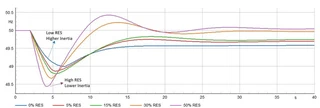 Disturbance event
Summary
The growing integration of renewable energy sources is compelling power system operators to decommission conventional power plants, resulting in a loss of inertia and frequency control capabilities. This shift has led the system to operate at marginal or even lower limits of frequency reserves, diminishing overall reliability. Consequently, there is a critical need to resize reserves using innovative techniques and explore new frequency reserve products to mitigate these challenges. This project focuses on the dimensional aspects of Inertia, FFR (Fast Frequency Response), FCR (Frequency Containment Reserve), FRR (Frequency Restoration Reserve), and RR (Restoration Reserve) to address and optimize the system’s response.
Project Objectives
The TSOC-OMP (TSOC Operating Margin Policy) project was initiated to address the critical challenges facing the Cyprus power system due to increasing renewable energy penetration. The main objectives include:
- Operating Margin Assessment: Comprehensive review and analysis of the current operating margin policy for the Cyprus Transmission System Operator (TSOC)
- Frequency Security Enhancement: Development of strategies to maintain frequency security in low-inertia conditions
- Reserve Sizing Optimization: Optimization of various frequency reserve types (FFR, FCR, FRR, RR) for the Cyprus power system
- Policy Recommendations: Formulation of new operating margin policies that accommodate the changing generation mix
Methodology
The methodologies used in this project focus on:
Theoretical Analysis
- System Limits Calculation: Mathematical modeling of frequency response characteristics under low-inertia conditions
- Reserve Requirements Assessment: Analytical determination of minimum reserve requirements for different contingency scenarios
Dynamic Simulations
- Time-Domain Analysis: Detailed simulation of frequency dynamics following large disturbances
- Scenario Analysis: Evaluation across multiple operating conditions and generation mixes
- Performance Metrics: Assessment of frequency nadir, rate of change of frequency (RoCoF), and settling time
Probabilistic Techniques
- Risk Assessment: Probabilistic evaluation of frequency security under uncertainty
- Monte Carlo Simulations: Statistical analysis of system performance across various scenarios
- Reliability Indices: Calculation of frequency-related reliability metrics
Machine Learning Approaches
- Data-Driven Optimization: Gradient-descent-based methods for reserve sizing
- Dynamic Security Assessment: Integration of DSA with linear predictions for optimal FFR allocation
- Pattern Recognition: Identification of critical operating conditions requiring enhanced reserves
Key Findings
The project has yielded several important insights for the Cyprus power system:
- Fast Frequency Response (FFR) Optimization: Development of novel data-driven methods for optimal FFR sizing in low-inertia grids
- Operating Margin Redefinition: Identification of new margin requirements that account for reduced system inertia
- Reserve Coordination: Strategies for effective coordination between different frequency reserve types
- System Resilience: Enhanced understanding of system behavior under extreme conditions
Impact and Outcomes
The TSOC-OMP project has contributed to:
- Policy Development: Informed the development of new operating margin policies for TSOC
- Operational Guidelines: Establishment of practical guidelines for frequency reserve management
- Research Advancement: Publication of findings in leading power systems journals
- Industry Collaboration: Strengthened collaboration between academia and the Cyprus TSO
Related Publications
The project findings have been published in peer-reviewed journals, including research on Sizing of Fast Frequency Response Reserves for improving frequency security in low-inertia power systems, demonstrating the practical application of the developed methodologies in real-world power system operation.
See also: Comparison of Fast Frequency Response Methods in the Low-Inertia Grid of Cyprus.
Industrial contacts
- Vrahimis Koutsoloukas (TSOC)
- Antonis Lazari (TSOC)
Source
Project page adapted from the Sustainable Power Systems Lab – TSOC-OMP description.

I am an enthusiastic electrical engineer researcher based in Cyprus, specializing in Energy Power Systems. From an early age, I have been passionate about programming, troubleshooting computer hardware, and experimenting with electrical systems. This passion led me to study electrical and computer engineering.
I am currently an Industrial PhD Student at the Electricity Authority of Cyprus and a Part-time Researcher at the Sustainable Power System Lab of the Cyprus University of Technology. On this website I share notes from my learning journey across power systems, programming, automations, Arduino, mathematics, and related topics.